
5th grade social studies curriculum for homeschool
ArgoLearn's 5th grade social studies is a full year of 180 lessons on the Western Hemisphere: its first peoples and ancient cities, conquest and the slave trade, the American Revolution and the Constitution, a nation that grows and splits in civil war, the long work for equal rights, and the lands, cultures, governments and economies of the Americas today.
Each week stays with one topic: three or four videos of 12 to 15 minutes, a hands-on day and usually a review day, and after every lesson come two quizzes that score themselves.
Lessons 1–5 of every subject are free. No credit card.
What your child learns in 5th grade social studies
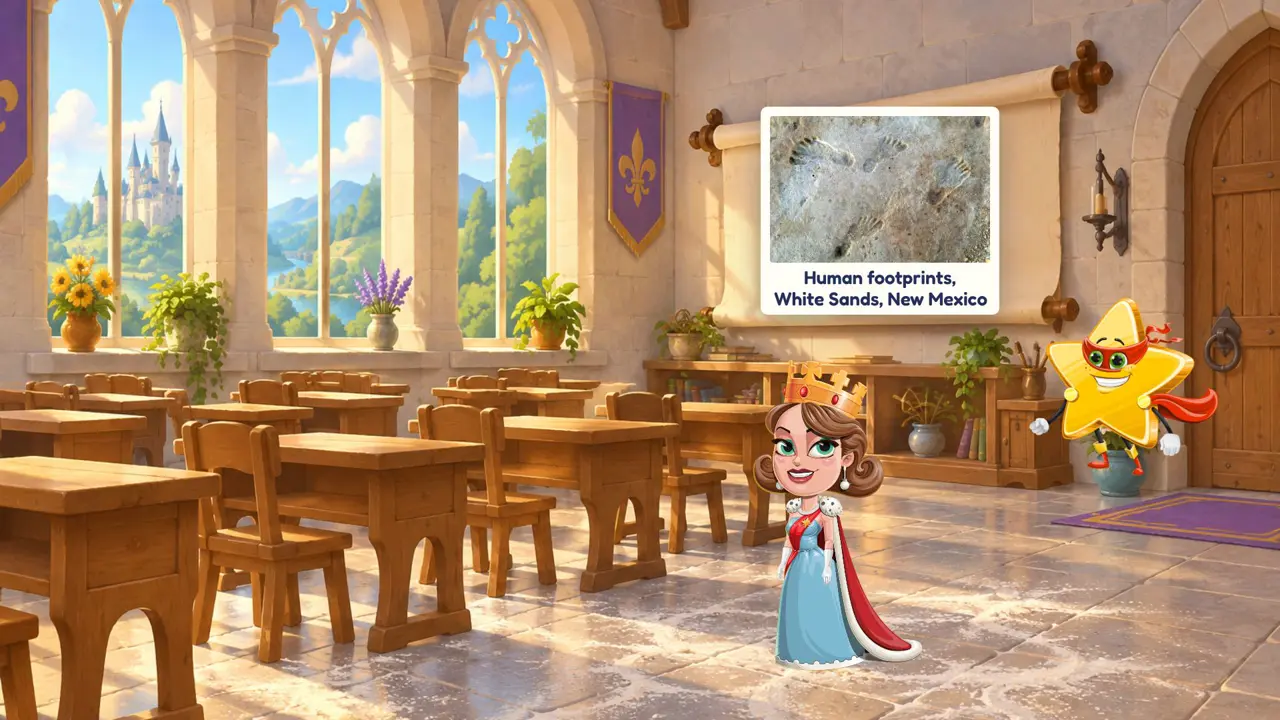
Fifth grade widens the map from one country to the whole Western Hemisphere. It begins with human footprints at White Sands in New Mexico, which three separate dating methods place at 21,000 to 23,000 years old, and with two ideas about how the first peoples arrived that scientists still test. The Maya and the Inca come before Columbus, Haiti's revolution is set beside the American one, and the later units cross into Canada, Mexico, the Caribbean and South America.
The first five units are history, from the first peoples to the Cold War; the last three turn to geography, cultures, governments and economies, ending with personal finance and the monarch butterfly's route. Sources are read for who made them and why: a painting made in 1851 is weighed against Washington's letter from the day after Trenton. Review days also work through the state capitals, region by region. The standard each lesson teaches is named on it, from the C3 Framework for Social Studies State Standards.
- Lessons
- 180, one for each school day
- Videos
- 120, each 12 to 15 minutes
- Hands-on days
- 36, one a week, with an activity at the table
- Quiz questions
- 1,800, graded for you
- Workbook pages
- 248 pages: one for every lesson and a grown-up guide for each topic, free as a PDF or printed
The year, week by week
Each column is a week of five lessons. Choose a week to see its five lessons.
- a video lesson
- a hands-on day
- a review day
Unit 1, weeks 1 to 5
First Peoples and Civilizations of the Americas
Based on current evidence, people reached the Americas at least 23,000 years ago, and your child weighs a land route across Beringia against a coastal route by boat. Homes and food are compared across nations, from Haudenosaunee longhouses to Inuit snow houses and Taíno bohíos. Then the great sites of North America: Poverty Point, Cahokia, Chaco Canyon and the Hohokam canals, and the 1800s myth of a lost race that the evidence disproves. The unit closes with the Olmec, the Maya and their base-twenty numbers, Mexica chinampas, and Inca roads and khipus.
25 lessons: 17 videos, 5 hands-on days and 3 review days
Week 1The First Peoples of the Americasfree
- 1DiscoverWelcome to Grade 5! How Do We Know These Footprints Are 23,000 Years Old?
- 2LearnWalk or Paddle? Testing Two Arrival Hypotheses
- 3Hands-OnAn Ice Age Valley Map
- 4Try ItWhich Hypothesis Wins (For Now)?
- 5Review & PlayThe First Peoples of the Americas
Week 2Many Nations, Many Environments
- 6DiscoverFlip-Flops for the Arctic? How Land Shapes Life
- 7LearnWhat Do a Longhouse, a Snow House and a Bohío Share?
- 8Hands-OnA Nation's Fact Sheet
- 9Try ItClimate Isn't Everything: Compare Two Nations
- 10Story TimeStory Time: The Three Clubhouses
Week 3Ancient Cities of North America: Poverty Point, Hopewell, Cahokia and Chaco
- 11DiscoverWho Built a Giant Earthwork Without Farms or Kings?
- 12LearnCahokia and Chaco: Where's the Throne Room?
- 13Hands-OnThree Sites, One Chart
- 14Try ItThe "Lost Race" Myth: Who Made It Up, and Why?
- 15Review & PlayAncient Cities of North America
Week 4What Makes a Civilization? The Olmec and the Maya
- 16DiscoverAre Giant Stone Heads Enough to Make a Civilization?
- 17LearnPicture or Sound? Cracking the Maya Code
- 18Hands-OnIs It a Civilization?
- 19Try ItDid the Maya Disappear? (Spoiler: No)
- 20Review & PlayWhat Makes a Civilization?
Week 5Empires of the Mexica and the Inca, and Their Peoples Today
- 21DiscoverHow Do You Feed 200,000 People on a Lake?
- 22LearnCan One Fast Star Beat the Inca Relay?
- 23Hands-OnMexica or Inca?
- 24Try ItMaya, Mexica, Inca: City-States or Empires?
- 25CelebrationUnit 1 Celebration: The Civilization Builders' Challenge
Unit 2, weeks 6 to 10
Encounters, Exchange and Colonies
Europeans sailed for spices, gold, religion and rivalry, and Columbus reached the Taíno in 1492. Your child learns why Tenochtitlan fell in 1521, with Indigenous allies and smallpox among the causes, and compares Cortés's letter with the Nahua elders' version in the Florentine Codex. The Columbian Exchange is traced on a lunch tray. West Africa comes next: Mali and Mansa Musa, the manuscripts of Timbuktu, the Middle Passage in historians' numbers and the people who resisted. The unit ends with the thirteen colonies, from Jamestown and the Mayflower Compact to town meetings.
25 lessons: 17 videos, 5 hands-on days and 3 review days
Week 6European Exploration and Conquest
- 26DiscoverCinnamon, Gold and Glory: Why Did Europeans Sail?
- 27LearnWho Really Brought Down Tenochtitlan?
- 28Hands-OnRead a Map From 1502
- 29Try ItMoctezuma Meets Cortés: Whose Story Do We Trust?
- 30Review & PlayEuropean Exploration and Conquest
Week 7The Columbian Exchange
- 31DiscoverWhat Crossed the Ocean? (And What Snuck Aboard?)
- 32LearnWho Gained From the Columbian Exchange, and Who Lost?
- 33Hands-OnTrace a Lunch Tray
- 34Try ItStowaways! The Exchange Nobody Planned
- 35Story TimeStory Time: The Pizza That Couldn't Exist (Yet)
Week 8West Africa, the Middle Passage and Slavery in the Americas
- 36DiscoverGold, Salt and Books: The Kingdoms of West Africa
- 37LearnThe Middle Passage: What the Numbers Tell Us
- 38Hands-OnA Factual Summary
- 39Try ItBrazil, the Caribbean and the Fight for Freedom
- 40Review & PlayWest Africa, the Middle Passage and Slavery in the Americas
Week 9Founding the Thirteen Colonies
- 41DiscoverWho Paid for Jamestown, and What Did They Want Back?
- 42LearnWhy Did the Pilgrims Sign a Promise Before Landing?
- 43Hands-OnCharter, Compact, Alliance or Law?
- 44Try ItThirteen Colonies, Thirteen Reasons? Map Them!
- 45Review & PlayFounding the Thirteen Colonies
Week 10Colonial Life: Work, Faith and Self-Government
- 46DiscoverFish, Wheat or Tobacco? Who Did the Work?
- 47LearnHow Loud Was Whitefield? Franklin Did the Math
- 48Hands-OnRead Three Colonial Sources
- 49Try ItWhy Couldn't the King Stop a Town Meeting?
- 50CelebrationUnit 2 Celebration: The Atlantic Crossroads Quiz
Unit 3, weeks 11 to 15
Revolution and a New Government
Parliament, not the king, passed the colonies' taxes, and Revere's engraving of the Boston Massacre is set beside trial testimony. Your child reads Common Sense and the Declaration's grievances, then the words of people its promise of equality left out, such as Abigail Adams and Prince Hall. A field trip visits Independence Hall and the Liberty Bell. The war is told through Trenton, Valley Forge and the many people who won it. Then come Shays' Rebellion, the Great Compromise, the Bill of Rights, checks and balances, and two Supreme Court cases about students' rights.
25 lessons: 17 videos, 5 hands-on days and 3 review days
Week 11The Road to Revolution, 1754–1775
- 51DiscoverWho Really Taxed the Colonies? (Not the King)
- 52LearnCan One Engraving Start a Revolution?
- 53Hands-OnEngraving vs. Testimony
- 54Try ItLong Fuse or Spark: What Started the Revolution?
- 55Review & PlayThe Road to Revolution, 1754–1775
Week 12Declaring Independence
- 56DiscoverHow Did One Pamphlet Talk a Country Into It?
- 57LearnIs a List of Complaints Good Evidence?
- 58Hands-OnGrievance to Evidence
- 59Try ItWho Else Used the Declaration's Words?
- 60Field TripField Trip: Independence Hall and the Liberty Bell
Week 13The Revolutionary War: People, Places and Turning Points
- 61DiscoverWhat Did the Famous Delaware Painting Get Wrong?
- 62LearnValley Forge: Was Snow the Real Enemy?
- 63Hands-OnStrengths, Weaknesses, Fixes
- 64Try ItWho's Missing From the Revolution's Story?
- 65Review & PlayThe Revolutionary War
Week 14From the Articles to the Constitution and the Bill of Rights
- 66DiscoverWhy Did Farmers Close the Courts in 1786?
- 67LearnBig States, Small States: Who Gets More Votes?
- 68Hands-OnSeats in the First Congress
- 69Try ItNo Bill of Rights, No Deal?
- 70Review & PlayFrom the Articles to the Constitution and the Bill of Rights
Week 15How the U.S. Government Works
- 71DiscoverWhy Does the Constitution Split Power Twice?
- 72LearnWho Gets the Last Word on a Law?
- 73Hands-OnPower Map
- 74Try ItDo Students Have Rights at School?
- 75CelebrationNew Government Celebration: Founders' Debate Night
Unit 4, weeks 16 to 20
A Nation Grows and Divides
George Washington sets the first precedents, and a revolution in Haiti leads France to sell its claim to Louisiana. An eyewitness, Paul Jennings, shows the famous story of Dolley Madison and Washington's portrait to be a myth. Independence spreads across the hemisphere, from Haiti in 1804 to Mexico and the armies of Bolívar and San Martín. Your child studies Cherokee removal and Worcester v. Georgia, visits the Gateway Arch and the Old Courthouse, and reads the seceding states' own reasons. Reconstruction and the end of slavery across the Americas close the unit.
25 lessons: 17 videos, 5 hands-on days and 3 review days
Week 16The New Republic, 1789–1815
- 76DiscoverHow Do You Invent a President From Scratch?
- 77LearnHow Did a Revolution in Haiti Double the U.S.?
- 78Hands-OnPrecedent Tracker
- 79Try ItWho Really Saved the Portrait in 1814?
- 80Review & PlayThe New Republic, 1789–1815
Week 17Independence Across the Americas, 1791–1825
- 81DiscoverWhy Did 1804 Change the Whole Hemisphere?
- 82LearnHidalgo, Bolívar, San Martín: One Hero or Many?
- 83Hands-OnSame Questions, Two Revolutions
- 84Try ItProtector or Bossy Neighbor? The Monroe Doctrine
- 85Review & PlayIndependence Across the Americas, 1791–1825
Week 18Westward Expansion and Its Costs
- 86DiscoverWhat Was This Painting Selling?
- 87LearnWorcester v. Georgia: Why Didn't the Ruling Stop Removal?
- 88Hands-OnRead a Diary Entry
- 89Try ItSame Land, Three Stories: The West in 1848
- 90Field TripField Trip: The Gateway Arch and the Old Courthouse
Week 19Slavery, Abolition and the Civil War
- 91DiscoverWhat Did the Underground Railroad Really Look Like?
- 92LearnWas the Civil War About States' Rights? Check the Sources
- 93Hands-OnTwo Sources, One Question
- 94Try ItHow Did the Union Win, and Who Made Freedom Real?
- 95Review & PlaySlavery, Abolition and the Civil War
Week 20Reconstruction and Freedom Across the Americas
- 96DiscoverAfter 1865: What Did Freedom Need?
- 97LearnWhy Did Reconstruction End Before Its Work Was Done?
- 98Hands-OnFreedom's Promises, 1865–1896
- 99Try ItWhich Country in the Americas Ended Slavery Last?
- 100CelebrationA Nation Grows Celebration: The Great Survey
Unit 5, weeks 21 to 24
Rights and a Changing Nation
The unit starts at Seneca Falls in 1848, compares two reports of Sojourner Truth's speech, and follows the vote to Tennessee in 1920. The United States becomes a world power: the sinking of the Maine, the Panama Canal, two world wars, the Great Depression and the New Deal, and a home front that was not the same for everyone. The civil rights week runs from Jackie Robinson and Brown v. Board to the Voting Rights Act, the Delano grape strike and a disability-rights sit-in. The United Nations and the Cold War end the unit.
20 lessons: 13 videos, 4 hands-on days and 3 review days
Week 21The women's rights movement
- 101DiscoverWhy Copy the Declaration of Independence in 1848?
- 102LearnTwo Reports of One Speech: Which Should We Trust?
- 103Hands-OnTwo Reports, One Speech
- 104Try ItThe Vote That Came Down to One Mother's Letter?
- 105Review & PlayThe women's rights movement
Week 22A world power: from 1898 to World War II
- 106DiscoverRemember the Maine? What Really Sank It?
- 107LearnWhy Was the New Deal Called Alphabet Soup?
- 108Hands-OnRead a Poster Like a Historian
- 109Try ItThe Home Front: Was It the Same for Everyone?
- 110Review & PlayA world power: from 1898 to World War II
Week 23The Civil Rights Movement and many movements
- 111DiscoverWhy Did 1865 to 1964 Take Ninety-Nine Years?
- 112LearnSit-In, March or Ballot: Which Tool Fits Which Goal?
- 113Hands-OnMethod, Goal, Result
- 114Try ItGrapes, a Ramp and an Island: Many Movements, One Idea
- 115Review & PlayThe Civil Rights Movement and many movements
Week 24Working together after World War II: the UN, the OAS and the Cold War
- 116DiscoverWhy Would 50 Countries Promise to Talk First?
- 117LearnWhat Did a 1962 Spy-Plane Photo Really Show?
- 118Hands-OnRead the Photo, Score the Cooperation
- 119Try ItCan Countries That Disagree Still Beat a Disease?
- 120CelebrationRights and a Changing Nation Celebration: On the Air
Unit 6, weeks 25 to 28
Lands of the Western Hemisphere
On Mercator's map, Greenland looks as big as Africa, which is about fourteen times larger, and that is where the geography begins. Your child learns the physical regions of Canada and Mexico and why most Canadians live near the U.S. border, then Central America on the Ring of Fire, the islands of the Caribbean, and the Andes, where bananas grow low and potatoes high. Natural resources follow, from Chile's copper to the cod fishery Canada closed in 1992, and then environmental challenges: hurricanes, deforestation seen by satellite and a Lake Erie agreement between two countries.
20 lessons: 13 videos, 4 hands-on days and 3 review days
Week 25Mapping the hemisphere and the geography of North America
- 121DiscoverIs Greenland Really as Big as Africa?
- 122LearnAlaska vs. Mexico: Which Is Bigger, Really?
- 123Hands-OnWhich Map for Which Question?
- 124Try ItWhy Do Most Canadians Live Near the U.S. Border?
- 125Review & PlayMapping the hemisphere and the geography of North America
Week 26Central America, the Caribbean and South America: lands and regions
- 126DiscoverCan a Spider Web Two Continents Together?
- 127LearnWhy Do Bananas Grow Low and Potatoes Grow High?
- 128Hands-OnStack the Climate Cake
- 129Try ItWhy Do So Many Cities Sit High in the Andes?
- 130Review & PlayCentral America, the Caribbean and South America: lands and regions
Week 27Natural resources of the Western Hemisphere
- 131DiscoverCan a Renewable Resource Still Run Out?
- 132LearnCopper, Silver, Soybeans: Who Has What, and Why?
- 133Hands-OnResource Map Detective
- 134Try ItIs There a Perfect Energy Source? Score the Trade-Offs
- 135Review & PlayNatural resources of the Western Hemisphere
Week 28Environmental challenges in the Western Hemisphere
- 136DiscoverNineteen Storms or One? Reading a Hurricane Season
- 137LearnWhat Can Satellites See That We Can't?
- 138Hands-OnSnapshot or Story?
- 139Try ItCan Two Countries Fix One Lake Together?
- 140CelebrationLands of the Hemisphere Celebration: The Atlas Rally
Unit 7, weeks 29 to 32
Neighbors: Peoples, Cultures and Governments
The unit begins with the ways people came to be in the United States, the Chinese Exclusion Act and the 1965 law that ended country quotas, and blends such as the banjo and hip-hop. Canada became independent step by step, by laws rather than war, and has two official languages and the territory of Nunavut. Your child reads a 1996 survey of children's favorite sports across Latin America, compares Día de los Muertos with Halloween, and sets the governments of the United States, Mexico, Brazil, Canada and Cuba side by side, without ranking them.
20 lessons: 13 videos, 4 hands-on days and 3 review days
Week 29Immigration and Culture in the United States
- 141DiscoverWho Came, Who Was Already Here, and Who Was Forced?
- 142LearnThe Law That Shut One Door for 61 Years
- 143Hands-OnA Census Table and a PRETEND Letter
- 144Try ItThe Banjo, the Bronx and a Borrowed Word
- 145Review & PlayImmigration and Culture in the United States
Week 30Canada: Peoples and Culture
- 146DiscoverHow Did Canada Become Independent Without a War?
- 147LearnWhy Does Canada Have Two Official Languages?
- 148Hands-OnThe Map That Hides People
- 149Try ItIs Canada Just Like the United States? Test It
- 150Review & PlayCanada: Peoples and Culture
Week 31Latin American Cultures
- 151DiscoverWhat Makes Latin America "Latin"?
- 152LearnIs Soccer Everyone's Favorite? Check the Chart
- 153Hands-OnOne Chart, Many Countries
- 154Try ItDía de los Muertos Is Not Halloween. Here's Why
- 155Review & PlayLatin American Cultures
Week 32Governments of the Western Hemisphere
- 156DiscoverCan a President Run Again? It Depends Where You Live
- 157LearnCanada and Cuba: Who Holds the Power, and Who Checks It?
- 158Hands-OnThe Rubric Table
- 159Try ItDesign a Government. Then Try to Break It.
- 160CelebrationNeighbors Celebration: Live From the Summit Desk
Unit 8, weeks 33 to 36
Economies and a Connected Hemisphere
Every economy answers what to produce, how and for whom, and a freeze in Florida's orange groves shows supply and demand at work. Your child follows a pretend car part that crosses a border three times between Canada, the United States and Mexico, and works out who pays a tariff. Personal finance comes next: gross and net pay, a budget with saving and giving, simple and compound interest worked in tokens, and the red flags of a scam. The year ends with a capstone on the monarch butterfly, whose migration needs three countries to cooperate.
20 lessons: 13 videos, 4 hands-on days and 3 review days
Week 33Economic Systems of the Western Hemisphere
- 161DiscoverThree Questions Every Economy Must Answer
- 162LearnA Freeze Hits the Orange Groves. What Happens to Juice?
- 163Hands-OnPrice Signals at the Market
- 164Try ItWhere Does Each Country Sit on the Spectrum?
- 165Review & PlayEconomic Systems of the Western Hemisphere
Week 34The Importance of Trade
- 166DiscoverThe Nine-Hour Pencil: Why Does Anyone Trade?
- 167LearnHow Many Times Can a Car Part Cross a Border?
- 168Hands-OnFollow the Part
- 169Try ItWho Pays a Tariff? Ask Four People
- 170Review & PlayThe Importance of Trade
Week 35Personal Finance: Earning, Saving, Borrowing and Banks
- 171DiscoverWhy Is Thorne's Paycheck Smaller Than His Pay?
- 172LearnInterest: Is It Working For You or Against You?
- 173Hands-OnSimple or Compound?
- 174Try ItIs Your Money Safe? Banks, Credit and Scams
- 175Review & PlayPersonal Finance: Earning, Saving, Borrowing and Banks
Week 36Capstone: Neighbors Across the Americas
- 176DiscoverWhy Does a Butterfly Need Three Countries?
- 177LearnWhose Great-Grandchild Finishes the Trip?
- 178Hands-OnRead the Migration Map
- 179Try ItOne Butterfly, Three Countries: What Can a Fifth Grader Do?
- 180CelebrationGrade 5 Celebration: The Americas, Premiere Night
Week 1, day by day
Every week has the same shape, so your child always knows what today is. This first week is free: these are its real lessons.
Day 1
Discover
Welcome to Grade 5! How Do We Know These Footprints Are 23,000 Years Old?
15-minute video
B.C.E.
Day 2
Learn
Walk or Paddle? Testing Two Arrival Hypotheses
12-minute video
During the Ice Age, water locked in ice sheets lowered the sea and exposed Beringia between Asia and North America; scientists test two hypotheses, a land route and a coastal route (perhaps both), by weighing evidence that can change their conclusions; a scale bar measures distance on a map; and nomadic hunter-gatherers, traveling with dogs, moved with the seasons to find food.
Day 3
Hands-On
An Ice Age Valley Map
Activities on screen, then 20 minutes at the table
Ice Age hunter-gatherers moved in a seasonal round, camping where food was ready in each season (fish runs in spring, ripe berries in summer, nuts to store in fall, a sheltered valley near the herds in winter); a scale bar turns a distance on a map into real miles; and a nomadic life had advantages, such as fresh food in every season and skills that worked for thousands of years, and challenges, such as carrying everything a long way.
Day 4
Try It
Which Hypothesis Wins (For Now)?
14-minute video
A strong scientific argument has a claim, evidence and reasoning; direct evidence shows something itself, indirect evidence shows only that it was possible, and missing evidence is a gap, not proof against an idea; independent evidence corroborates a finding; and careful conclusions say "based on current evidence" because new discoveries can change them.
Day 5
Review & Play
The First Peoples of the Americas
Review games and two quizzes
Try three questions from Lessons 1, 2 and 4
Two short quizzes follow every lesson. A miss gets a second try, then the reason.
A museum timeline lists three objects: a clay pot from 800 B.C.E., a carved bead from 1200 B.C.E. and a basket from 300 C.E. Which list goes from OLDEST to NEWEST?
B.C.E. years count backward, so the bigger B.C.E. number is older: 1200 B.C.E. comes before 800 B.C.E. Every C.E. year comes after every B.C.E. year, so the basket is newest.
On a map of the Americas, the scale bar shows that 1 centimeter stands for 500 kilometers. Two ancient campsites are 7 centimeters apart on the map. About how far apart are they?
Each centimeter stands for 500 kilometers, so 7 centimeters stand for 7 × 500 = 3,500 kilometers. On foot or by boat, the real trip would be even longer than the straight line.
Which is DIRECT evidence that people lived in a river valley 12,000 years ago?
Direct evidence shows something itself. A dated hearth shows real people built a fire there at a measured time. Water, berries and ice-free land show only that people COULD have lived there.
Day 3, at the table
Draw a PRETEND seasonal round
About 20 minutes
You need
- A sheet of paper
- Colored pencils or crayons
- A ruler
What you do
- Together, draw a PRETEND valley with a river, a sunny meadow, a grove of trees and a sheltered spot. Add a north arrow.
- Add a scale bar where 1 inch stands for 1 mile, and draw the four places a few inches apart.
- Your child writes a season beside each place, with one reason: what is ready to eat there, or what shelter it gives, in that season.
- Use the ruler and the scale bar to measure the trip from each camp to the next, then add up the whole round.
- Your child says, or writes in two sentences, one advantage and one challenge of moving with the seasons.
Ask your child
- Why would a group move camp instead of staying in one place all year?
- What could make a hard year for a group that moves with the seasons?
What your child will be able to do
Each lesson names the standard it teaches. These are the 49 standards this year's lessons carry, from the C3 Framework for Social Studies State Standards, in plain words.
By the end of the year, your child:
History
- makes and reads timelines of related events, then compares what was happening at the same time in different places, like their town, their state and the nation. D2.His.1.3-5
- learns how historians use different kinds of sources, like letters, photos, maps, tools and newspapers, to explain past events, and sums this up in their own words. D2.His.9.3-5
- makes a claim about the past and backs it up with evidence from sources, like using diary entries and photos to show how hard pioneer travel was. D2.His.16.3-5
- compares what different sources say about the past, like a diary, a newspaper and a painting from the same time, and notices where they agree or disagree. D2.His.10.3-5
- explains likely causes and effects of past events, like why the colonists wanted independence and how the railroad changed towns, travel and jobs. D2.His.14.3-5
- decides how useful a source is for a topic by checking who made it, when and where, who it was for, and why it was made. D2.His.13.3-5
- learns that the people who made historical sources had their own points of view, which shaped what they wrote, drew or left out in letters, diaries and newspapers. D2.His.6.3-5
- learns why people living at the same time saw things differently, like colonists who wanted independence and those loyal to the king, or settlers and Native nations. D2.His.4.3-5
- studies a historical source, like a poster, letter or advertisement, for clues about who it was made for and why: to inform, persuade, remember or sell. D2.His.11.3-5
- learns how the time and place people lived in shaped their views: a pioneer farmer, a ship captain and a city shopkeeper in 1800 each cared about different things. D2.His.5.3-5
- asks thoughtful questions about people and groups who shaped history, like Benjamin Franklin, the Wright brothers or Harriet Tubman: what they changed, what stayed the same, and why. D2.His.3.3-5
Geography
- uses maps, satellite images and photos to explain how where a place is affects its land and weather, like why places near the equator are hot and mountaintops snowy. D2.Geo.2.3-5
- learns how natural resources shape where people settle and move: towns near rivers and good farmland, ports on coasts, and mining towns near gold or coal. D2.Geo.8.3-5
- learns how land, weather and culture affect how people, goods and ideas move: rivers and roads speed travel, mountains slow it, and shared languages help ideas spread. D2.Geo.7.3-5
- learns how people's traditions and ways of life shape how they change and adapt to their land: houses on stilts, rice grown on hillside steps, or fishing villages. D2.Geo.4.3-5
- learns why world regions have different weather and land: being near the equator, near an ocean or high in the mountains helps explain deserts, rainforests and icy poles. D2.Geo.10.3-5
- learns how big disasters, like hurricanes, earthquakes, the Dust Bowl or a dam failing, can damage towns and lead people to rebuild or move somewhere new. D2.Geo.9.3-5
- uses maps that show small and large areas, from a neighborhood map to a world map, to find rivers, mountains, cities, farms and landmarks. D2.Geo.3.3-5
- learns how places change over time: a farm town grows into a city, new people bring new foods and customs, and forests, rivers and coasts change too. D2.Geo.5.3-5
- draws maps, diagrams and simple charts of places they know, like home or a park, and places they are learning about, like a state or another country. D2.Geo.1.3-5
- learns why many people live in some places and few in others: rivers, flat land, good soil, mild weather, jobs and family ties draw people together. D2.Geo.6.3-5
- learns how natural and human-made disasters in one place affect people far away: a drought raising food prices, a factory fire causing shortages, or volunteers sent to help. D2.Geo.12.3-5
Civics
- learns why governments began and how different kinds work, from kings and queens to democracy, including the three branches set up by the U.S. and state constitutions. D2.Civ.5.3-5
- learns how groups, from a club or classroom to a town or country, make rules that give people responsibilities and protect their freedoms. D2.Civ.4.3-5
- learns to make group decisions thoughtfully: sharing ideas, listening to every side, weighing the reasons and then voting or reaching an agreement together. D2.Civ.9.3-5
- sees the good and the hard parts of working together in families, workplaces, volunteer groups and government: sharing the work, but also handling disagreements. D2.Civ.6.3-5
- learns where rules and laws come from and why we have them, and meets key parts of the U.S. Constitution, like the Preamble and the Bill of Rights. D2.Civ.3.3-5
- names the big ideas that guide our government and communities, like fairness, equality, freedom, the rule of law, honesty and responsibility. D2.Civ.8.3-5
- learns how rules and laws change the way people live, like seat belt or recycling laws, and how people work to change laws they think need improving. D2.Civ.12.3-5
- learns who does what in town, state and national government: mayors, governors and the President lead, lawmakers make laws, and judges decide cases about the law. D2.Civ.1.3-5
- learns that a democracy depends on people taking part responsibly: voting, staying informed, following laws, serving on juries and helping their communities. D2.Civ.2.3-5
- learns ways people have worked to change society, long ago and today: voting, writing letters, speaking at meetings, gathering signatures, peaceful marches and volunteering. D2.Civ.14.3-5
- learns how leaders and citizens make plans and rules to fix shared problems, like an unsafe street crossing, litter in a park or a crowded school. D2.Civ.13.3-5
- learns why people see community questions differently, like where to put a new park: beliefs, experiences and values shape everyone's views, including their own. D2.Civ.10.3-5
- compares how decisions get made in different places: a class vote, a club meeting, a town council and Congress passing a law. D2.Civ.11.3-5
Economics
- learns why people and businesses focus on what they do best, like baking bread or growing apples, and trade for the other things they need. D2.Eco.4.3-5
- spots incentives, the rewards and penalties that shape choices: sales, prizes and allowance for chores, or late fees and fines that make people think twice. D2.Eco.2.3-5
- learns three big economic words in simple terms: inflation means prices go up, deflation means prices go down, and unemployment means people want work but cannot find jobs. D2.Eco.11.3-5
- learns the three kinds of resources used to make goods and services: natural resources like wood and water, workers' skills, and tools, machines and buildings. D2.Eco.3.3-5
- compares benefits and costs before choosing: what they gain and what they give up, like buying a snack now or saving for a book later. D2.Eco.1.3-5
- learns how profit, the money left after paying costs, guides sellers: what to make, how much to charge and whether to keep a business going. D2.Eco.7.3-5
- learns how governments pay for roads, schools, parks and firefighters: mostly through taxes that people and businesses pay, plus fees like park passes and tolls. D2.Eco.12.3-5
- learns how trade makes countries depend on each other more and more: we buy bananas, coffee and phones from other nations, and they buy our crops, airplanes and movies. D2.Eco.14.3-5
- learns how trade between countries helps and challenges different groups: shoppers get more choices and lower prices, while some workers gain new jobs and others lose theirs. D2.Eco.15.3-5
- learns that building skills through school, practice and training helps people do their work better and can lead to better jobs and pay later on. D2.Eco.6.3-5
- learns how people get more done with better tools and stronger skills: a tractor instead of a hoe, a computer instead of paper, or extra training on the job. D2.Eco.13.3-5
- learns what an interest rate is: how much extra money a borrower pays, or a saver earns, such as a bank adding a little to savings each year. D2.Eco.10.3-5
- learns about other money businesses besides banks, like credit unions, insurance companies and investment firms, and how they help people save, borrow and guard against big losses. D2.Eco.9.3-5
- spots how one person's choices can help or cost others nearby: a neighbor's flower garden everyone enjoys, or loud music and litter that bother the whole street. D2.Eco.8.3-5

The Grade 5 Social Studies workbook
After each lesson's video and its two quizzes, your child completes the lesson's page in this workbook. It has a printable page for every lesson, 248 pages in all, with a grown-up guide for each topic. Get the whole book free as a PDF, or order it printed from your parent account.
Get the free Grade 5 workbooksKeep looking
The rest of 5th grade
Start with week 1
Make a family account, add your child, and the first five lessons of 5th grade social studies are open. So are the first five of every other subject.
Lessons 1–5 of every subject are free. No credit card.